Glimpse - BFF & Couples Widget
Launching Private Social App from 0-1
400+
Users in first 21 days
4
Person Team
E2E
PMM Ownership
The Context
Challenge
Few private, lightweight social apps existed for close friends and couples. The biggest platforms had all drifted toward performance and public sharing.
Approach
Conducted user research to validate the market gap, then defined the messaging and positioning that shaped everything from the app's name to its App Store listing. Partnered with our product designer to bring the brand identity to life.
The Impact
Results
Launched a live product in 21 days with a 4-person team. Built acquisition channels across Apple Search Ads, Meta ads, and organic, with influencer partnerships in pipeline for scale.
Case Study
Finding the Gap
What started as a hackathon idea became the first product I owned end-to-end as a product marketer. We ran internal focus groups with Gen Z and younger Millennials to understand their relationship with social media and digital connection. We heard the four major frustrations:
People are posting less on big social because algorithms, ads, and the shift toward public content pushed their friends and family out of the feed.
Anxiety about who could see their posts, from acquaintances to old coworkers.
Fatigue from never-ending text chains, but still wanting to stay in touch.
Every major social platform had moved toward public performance. Instagram, Snapchat, and even BeReal, which had built its entire brand on authenticity, had all drifted toward performance and public consumption. Very few had built the opposite: something small, private, and effortless for the people who actually matter to you.
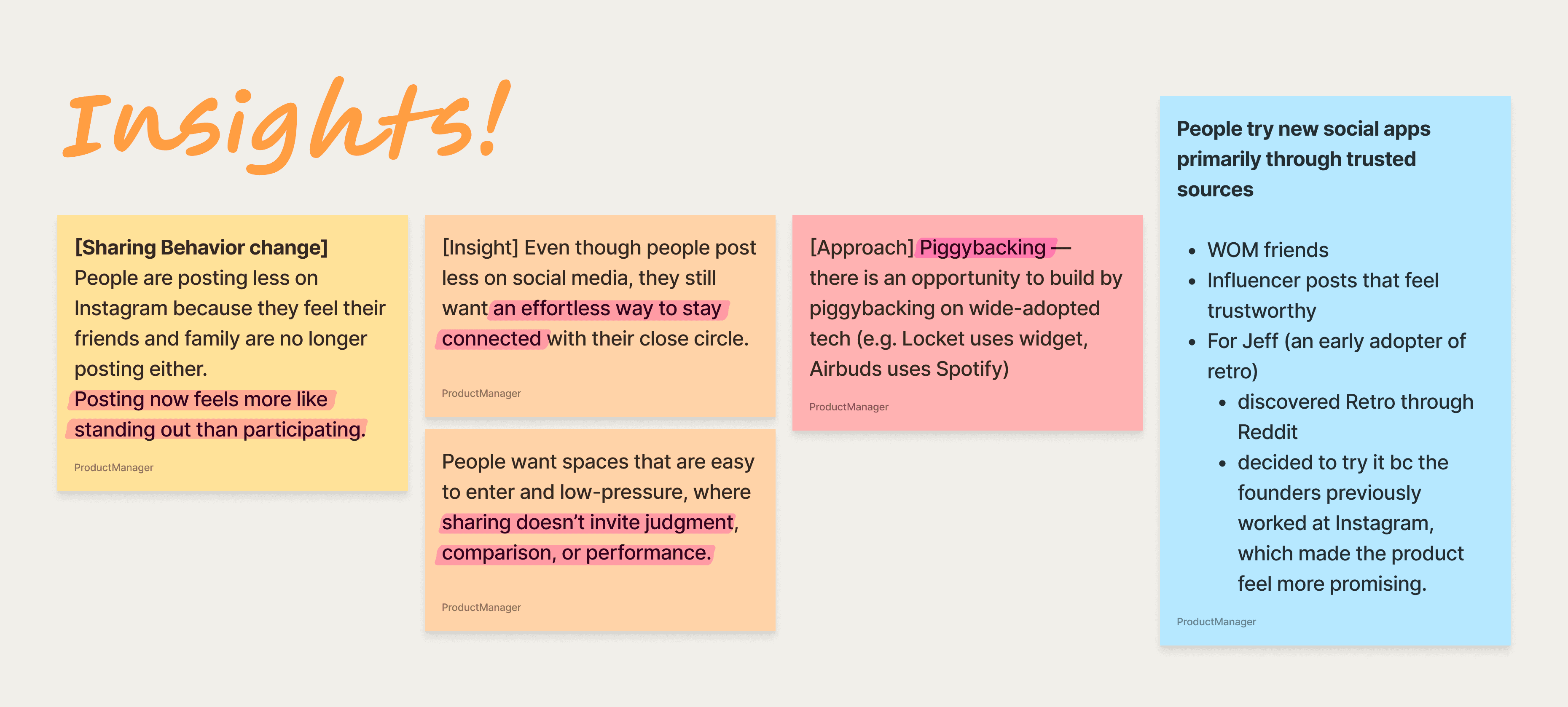
Internal focus session insights
Competitive Analysis
Before defining the product, I mapped the competitive landscape, plotting competitors on a scale of private to public social and curated to candid content. We wanted to be as true to private and candid as we could get.
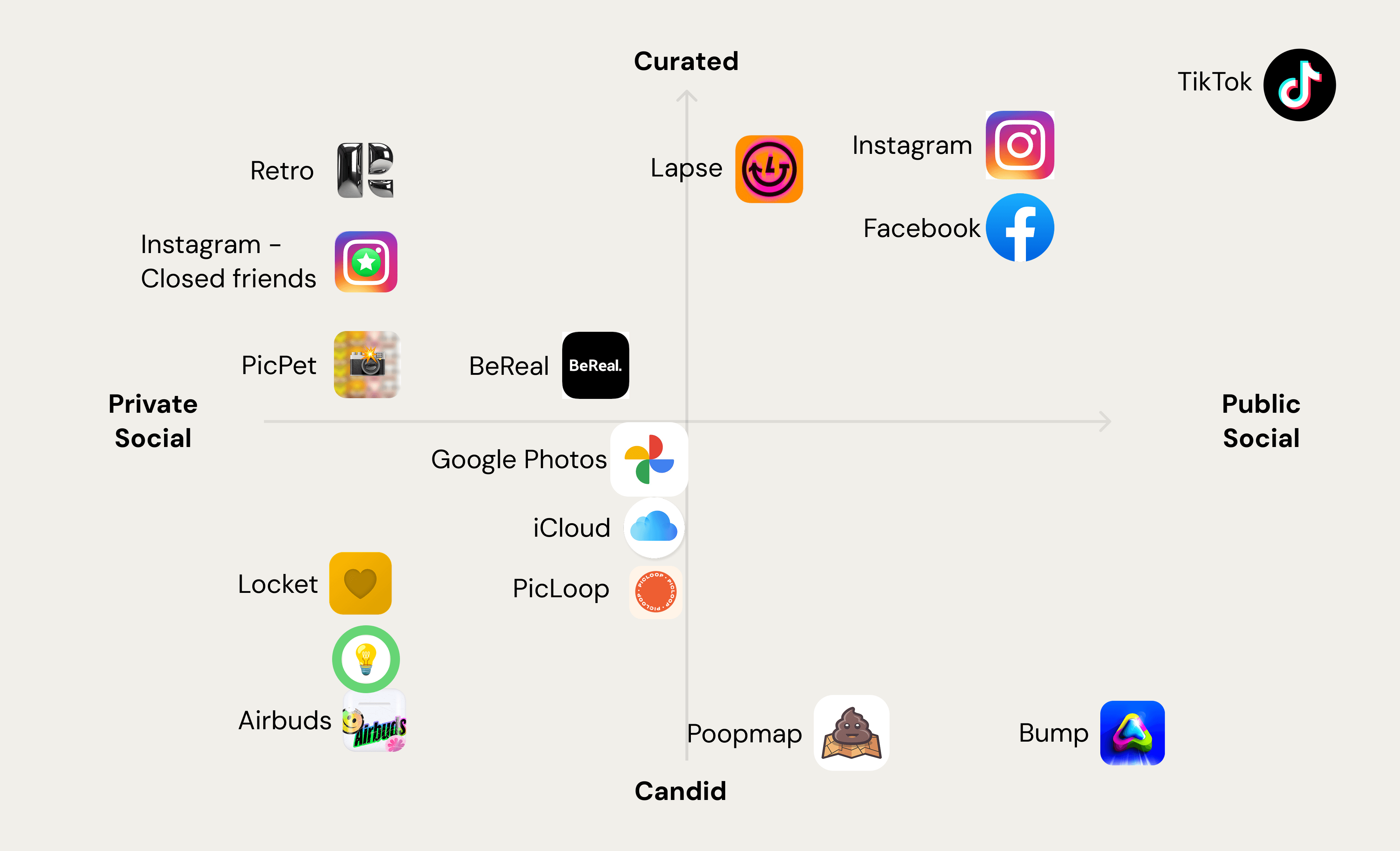
Competitive landscape chart
Locket had proven demand for home screen photo widgets, but it had turned noisy, ad-heavy, and shifted towards volume over intimacy. BeReal had introduced the idea of authentic sharing but drifted toward public performance. Snapchat and Instagram were too broad to feel personal anymore.
The gap was clear: The apps that started in this space had all drifted toward volume, performance, or public sharing. No one had stayed small and private.
Positioning and Messaging
The core positioning came directly from research. People didn't want another social app. They wanted a way to feel connected to the people they care about without the pressure of posting publicly.
Explore, PicCollage's division for building new apps with emerging technologies, encouraged us to experiment with technology we hadn't tried before, and for a team that had spent years in mobile apps, it was a wonder that none of us had built with widgets yet. The average person visits their home screen 144 times a day (according to a 2023 Fortune article)—if we wanted a frictionless way for friends to stay in touch, that was the perfect placement. I coined the tagline 'A little window to your favorite people' to capture this.
So we positioned Glimpse not as a social media app, but as a private sharing tool for your closest people. The messaging centered on three ideas: effortless sharing, no public audience, and built for real relationships.
From MVP to Differentiation
We had our positioning. But when the MVP came together midweek, the product didn't reflect it. It felt too close to Locket, a well-established competitor already embedded in our target audience. Beyond letting users attach emojis to a shared pinboard and branding, we had no meaningful differentiators, and they had a head start on brand recognition.
As the product marketer, I had to be honest with my team: I didn't see a path to successfully marketing an app with so little distinction. They heard me out and we went back to the drawing board, but we didn't have enough time to fully develop a new direction before the stakeholder presentation. So we presented what we had, transparently, with a roadmap for how we'd address it.
The feedback from stakeholders and our original focus group was overwhelmingly positive, enough to earn continued support and move into full development. That's when the real brand-building started.
Naming and Brand Development
The name needed to capture what the app actually felt like: a small, intimate window into someone's day. "Glimpse" did that naturally. It's short, easy to remember, and signals something quick, personal, and low-pressure.
I evaluated five name candidates against criteria including ASO competition, tagline potential, trademark risk, and alignment with our positioning. 'Glimpse' won because it directly tied to the product experience, had clear value proposition language built in, and had very little ASO competition.
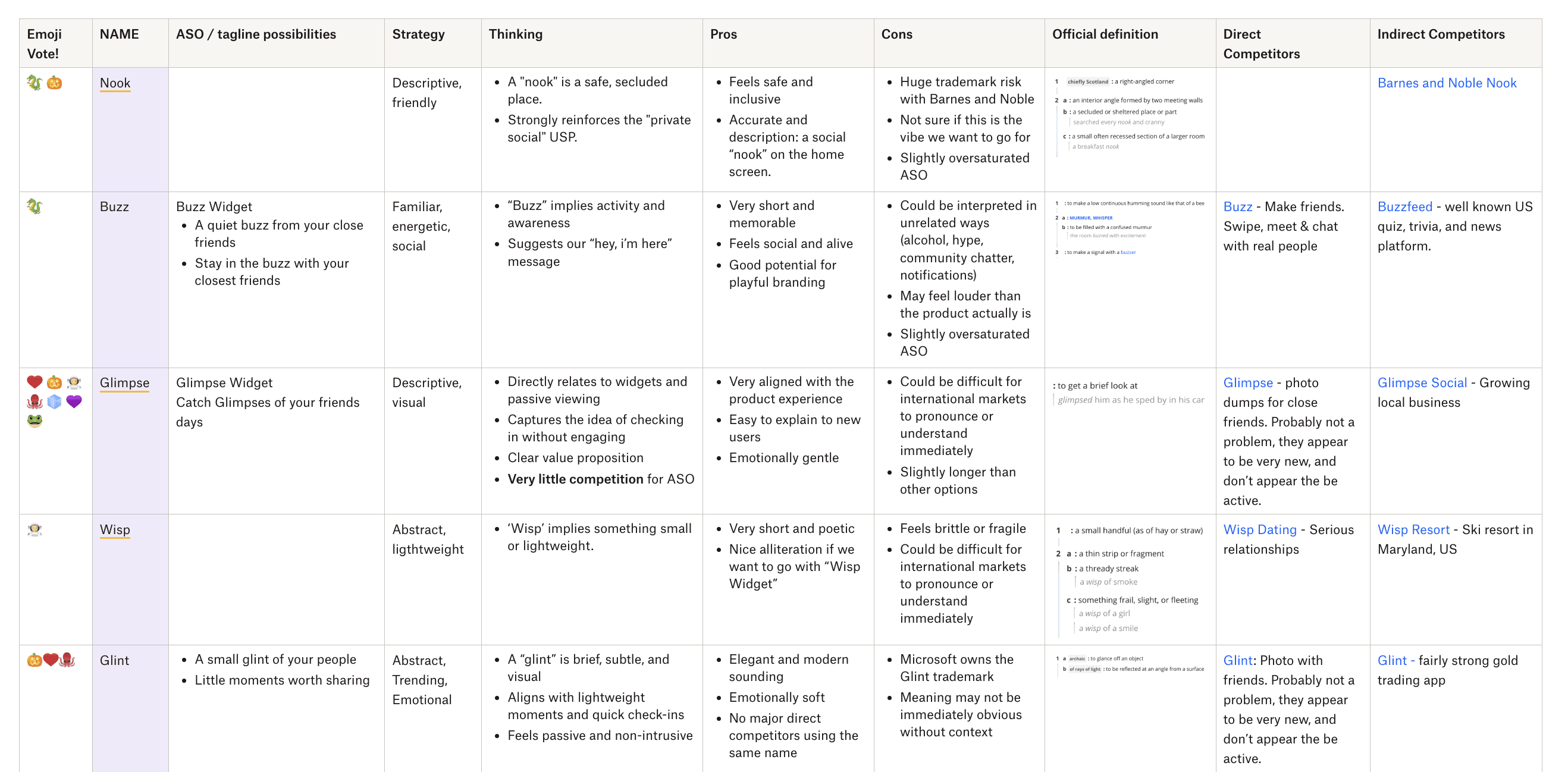
Glimpse naming paper
I also partnered with our product designer to develop a brand identity that matched: warm, approachable, and tied to our tagline, 'A little window to your favorite people.' Together we explored app icon directions, UI design feel, and brand colors.

Glimpse branding mood board
App Store Strategy
The App Store listing was one of the highest-leverage assets for a 0-1 launch. It was essentially our storefront and had to represent the brand well. I researched keyword volume and difficulty across terms like 'photo widget,' 'couples app,' 'BFF widget,' and 'long distance' to find the best positioning opportunity for our ASO.
The final title and subtitle balanced discoverability with clarity, making it immediately obvious what Glimpse was while targeting keywords with strong search volume and low competition. I wrote all App Store copy, including the description and screenshot captions, to reinforce the private-sharing positioning.
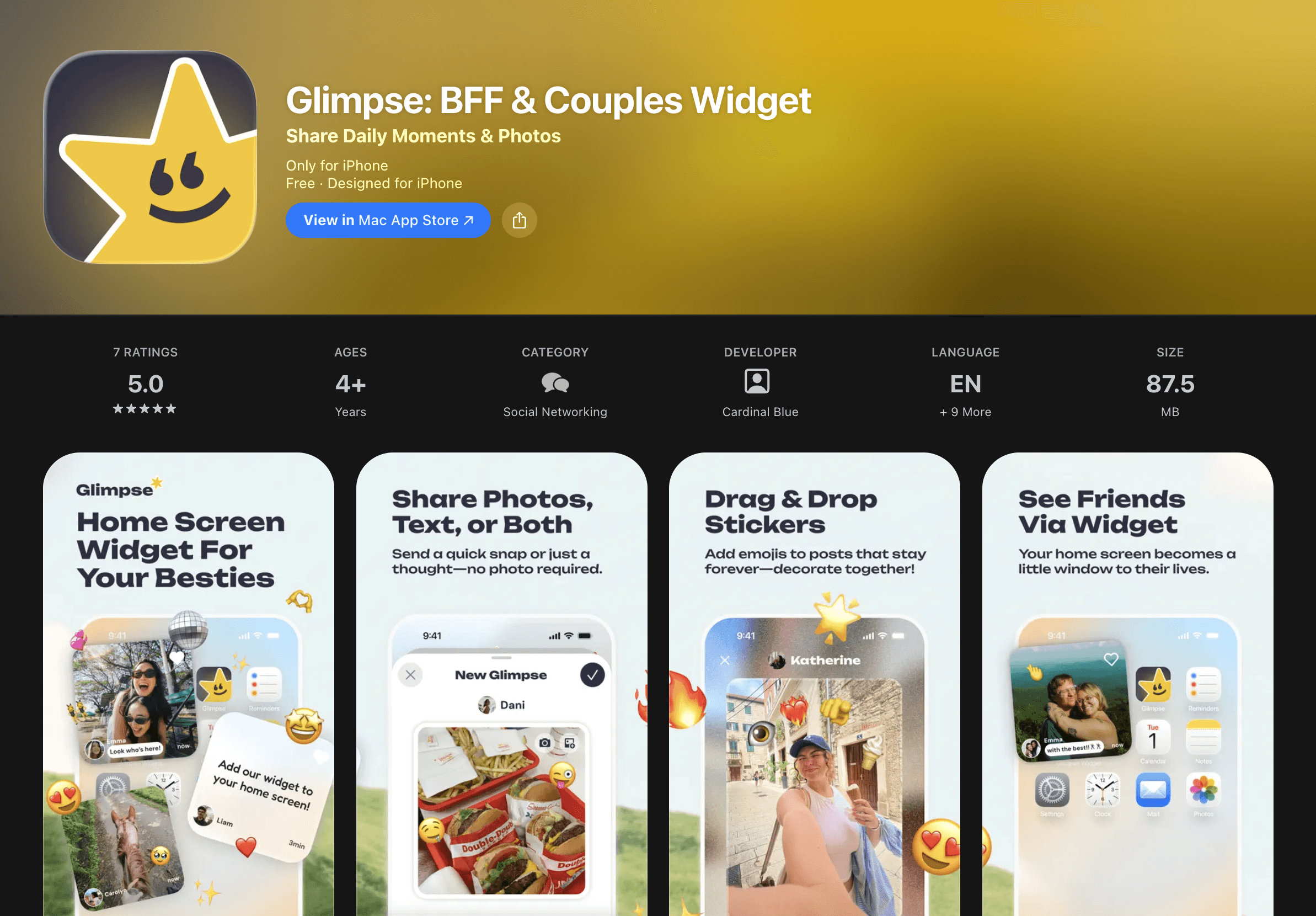
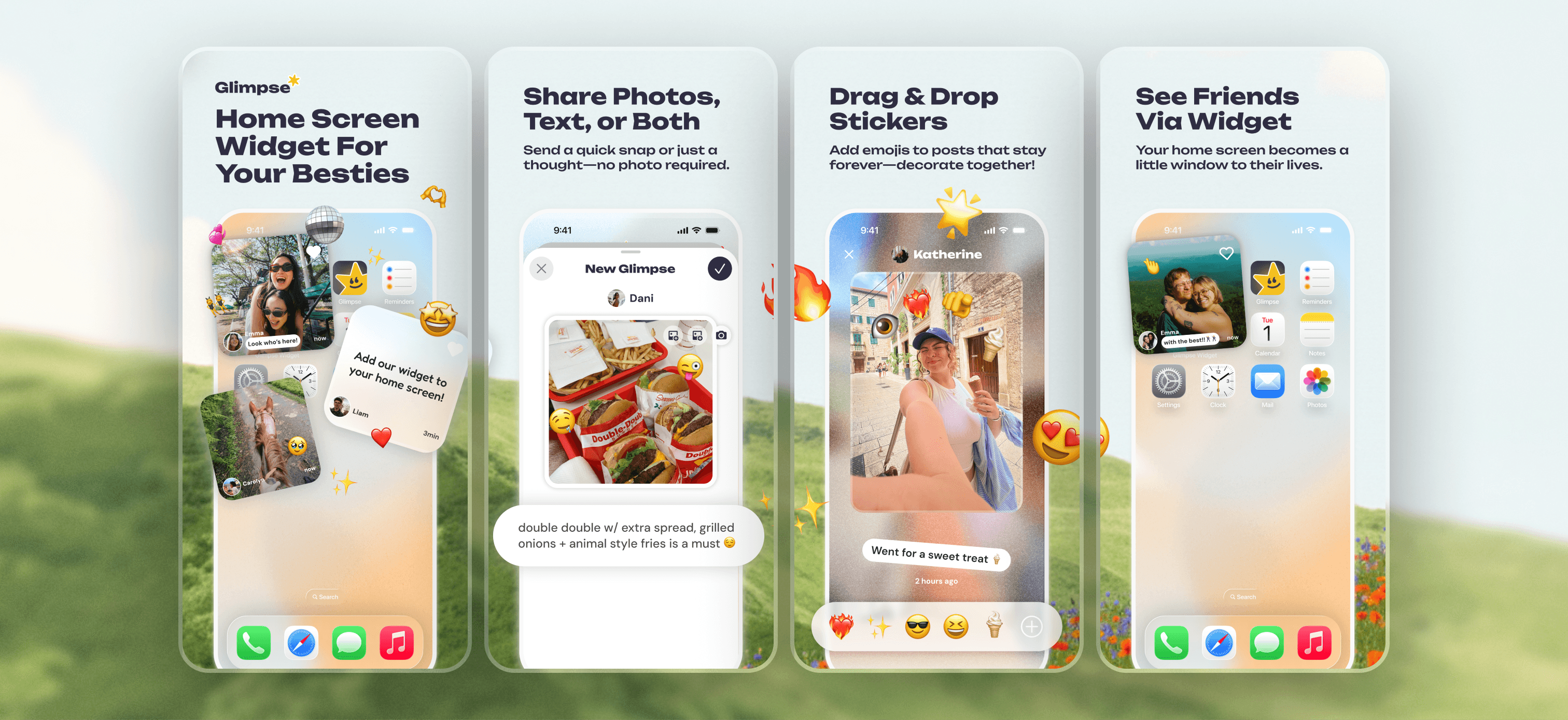
Glimpse US App Store Listing
I also designed the screenshots, which meant balancing visual storytelling with ASO. App Store search now indexes text in screenshots, so every caption had to work double duty: communicating value to someone browsing while targeting the right keywords for discoverability. 'Home Screen Widget For Your Besties' and 'See Friends Via Widget' speak directly to the use case while hitting high-intent search terms.
Acquisition and Launch
We launched with a lean approach: Apple Search Ads targeting high-intent keywords in both US and Taiwan, App Store optimization, and early word-of-mouth from our research participants. This is what helped us scale to 400+ users in 21 days.
We also saw an opportunity to localize for the Taiwanese market. Several smaller social apps had gained traction in Taiwan, and we had an advantage most startups don't: native Traditional Chinese speakers on our team. I worked with them to translate the app, App Store listing, and ad creative in time for launch, and we ran Apple Search Ads in Traditional Chinese from day one.
Glimpse is far from over. On the roadmap we have Meta Ads, influencer partnerships, feature development to drive further differentiation, and continued work on retention and engagement.
Conclusion
Key Takeaways
Push Back Early, Not Late
Product marketing starts before launch. Sometimes the most important marketing decision is telling your team the product isn't ready.
Social Apps Play By Different Rules
You're not just convincing someone to download, you're convincing them to bring their friends. That changes everything: your messaging, your channel strategy, your onboarding. Every touchpoint has to reduce friction for both the user and the people they're inviting.
Small Teams Force Clarity
With four people and limited resources, there was no room for ambiguity. Every decision, from channel selection to creative direction, had to be intentional. That constraint made me a sharper marketer.